Engineering Trust Through Smart Data: Competition and Concentration in DACH
- Wanice Alfes

- vor 5 Tagen
- 4 Min. Lesezeit
Wanice ALFES
ViSP-Lab · Human–AI Cognitive Engineering · Cyberpsychology

(Wanice Alfes_OECD_Competition Open Day 2026)
There is a word that appears in almost every AI governance discussion about market dynamics, and it is used as though its meaning is self-evident: competition. For a US-trained AI system, it is. Competition encodes acceleration, differentiation, merit-based superiority, market dominance, and performance visibility. It derives from the Latin competere — to strive together in a shared arena, to outperform within recognised rules. Smart data trust engineering in DACH environments requires a different approach.
But for a DACH-based user, the relevant word is not competition. It is Wettbewerb. And Wettbewerb is not a translation of competition. It is a different cognitive architecture entirely.
Wettbewerb derives from Old High German wettōn — to pledge, to promise, to stake. Its root is related to Bürge, the guarantor. The underlying structure is not striving to outperform. It is responsibility within a legitimate, structured field.
The DACH user does not ask: can this system help me win? They ask: can this system demonstrate that it belongs here, that it operates according to legitimate principles, that its outputs are reliable enough to stake something on?
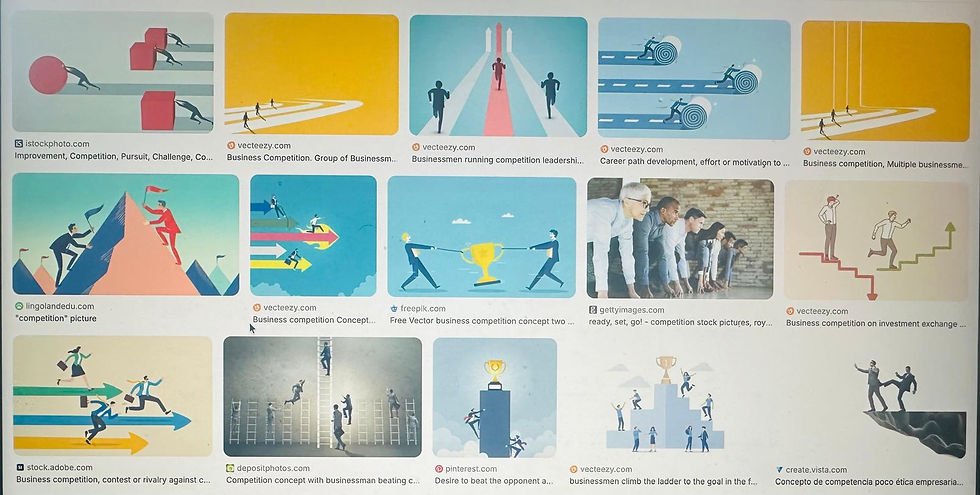
(Search Brave 20.05.2026 - Term: Competition__ViSP-Lab)

(Search Brave 29.05.2026 - Term: Mittbewerb_ViSP-Lab)
When a US-conditioned AI system responds to a DACH user's question about market positioning with aggressive scaling strategies and competitive differentiation language, the system is not making a linguistic error. It is activating the wrong psychological contract. The user perceives aggressiveness, reduced institutional credibility, and a diffuse sense that the system does not understand the environment it has entered. The failure is architectural, not lexical.
This is what ViSP-Lab means by cognitive design misalignment — and it is precisely the problem that smart data is positioned to address, provided it is used correctly.
Smart Data Trust Engineering: Not Smaller Big Data
The most common misunderstanding about smart data in AI deployment is that it is simply a scaled-down version of mass data collection — fewer records, same logic. It is not. Smart data is a methodological choice to generate high-inference, low-volume signals within constrained environments, rather than to extract low-inference, high-volume signals from general populations.
Smart data trust engineering in DACH
In the context of trust engineering, this distinction is critical. The Law of Gravity for Trust proposes that trust forms primarily through four variables: Consistency at approximately 40%, Perceived Inferential Distance at 30%, Coherence at 20%, and Meaning — the semantic and cultural calibration layer — at 10%. Smart data trust engineering is the operational response to this condition.

This distribution has a counterintuitive implication:
The variables that carry the most structural weight are precisely those that mass data collection is worst at measuring
Consistency requires longitudinal interaction data within defined contexts
Inferential distance requires cluster-specific signal interpretation
Coherence requires multimodal alignment data
None of these emerge cleanly from undifferentiated user behaviour logs.
Smart data, by contrast, is generated within constrained environments specifically designed to produce coherent signals for each of these variables. One specific semantic object. One defined interaction ecology. One cluster. The data that emerges is not a statistical sample of general behaviour. It is a precision instrument for measuring trust formation in a specific cognitive-cultural context.
The concentration question is not about market structure
The tension between competition and concentration that gives this post its title is often framed as a regulatory or antitrust question — about market power, about BigTech, about platform dominance. These are legitimate concerns. But for Human-AI cognitive design, the relevant question is different.
Concentration in the ViSP-Lab framework refers to the deliberate accumulation of cognitive-operational density within a defined architecture — the construction of internal conditions that make selective, strategic, and semantically legible cooperation possible. A concentrated AI deployment does not mean a monopolistic one. It means one that has been calibrated for a specific trust architecture rather than deployed as a universal semantic default.
Switzerland's regulatory trajectory — the nDSG, FINMA Guidance 08/2024, the Digital Switzerland Strategy — collectively creates an institutional environment that structurally favours this kind of concentrated deployment: constrained data environments, minimal data footprint, high-inference-per-datum approaches, and trust as the primary performance criterion. The strategic choice has been made. What has not yet been specified is the interaction design methodology that operationalises it at the level where users actually experience it.
What engineering trust actually requires
Trust in Human-AI systems is not produced by optimising engagement metrics. The Supermarket of Placebos — the structural condition in which optimisation systems substitute measurable proxies for meaningful outcomes — produces exactly the failure mode that Swiss fintech pilots are currently documenting: systems that perform technically in controlled conditions and stall in production deployment because the trust architecture was never designed.
Engineering trust requires, in sequence, the conditions that the METAP4-Method specifies.

Personalised first — one smart objective in a constrained environment with smart data, not comprehensive profiling.
Participatory second — the user's responses in that conditioned environment are the data, not extracted from prior behaviour but created through calibrated interaction design.
Predictive third — possible only because participation has generated coherent signals, not assumed from population averages.
Preventive fourth — emerging as an intended consequence of the first three steps correctly sequenced, not designed as a starting objective.
A financial institution that deploys a US-trained AI system and wonders why DACH-international users describe it as generic, artificial, or untrustworthy is not facing a data quality problem. It is facing a sequencing problem. The trust architecture was never established before the complex interaction began. The system entered the Wettbewerb without demonstrating it belonged there.
Smart data in constrained environments, calibrated for the trust architecture of a specific cluster, sequenced through the METAP4 method — this is what reconciles competition and concentration in cognitive design. Not by choosing one over the other, but by designing the conditions under which the user's cognitive architecture is met before the interaction demands anything from it.
Words translate. Psychological contracts do not. And trust is built at the layer of the contract, not the word.
For ViSP-Lab's approach to regional trust calibration in fintech environments, see the Die Brücke pre-pilot specification and Working Paper WP01-2026.
ViSP-Lab · Human–AI Cognitive Engineering
ViSP-Lab is an independent research and development laboratory based in Bad Homburg, Germany. The lab investigates how trust, communication, cognition, and regional interpretation shape cooperation between humans and AI systems.


Kommentare