When the Wrong Ticket Becomes an Experiment in User Retention
- Wanice ALFES

- 7 days ago
- 11 min read
Updated: 6 hours ago
Insights for user retention with The Law of Gravity for Trust, and the Regional Communication Risk Calibration (RCRC) framework.

Wanice Alfes · ViSP-Lab · Bad Homburg · 03.06.2026
A few days ago, I bought the wrong flight ticket.
Not the wrong destination. Not the wrong date. Not even the wrong airline.
The wrong relationship.
The ticket was technically correct. The flight existed, the booking was confirmed, the payment was processed, and the route was exactly the one I needed.
From a dashboard's point of view, everything was a success.
Only in the dashboard...
A confusion that turned into a goldmine for communicational analysis in user retention
In the rush between a work marathon at ViSP-Lab and booking a trip, I read the confirmation carefully only afterwards — and realised the airports were inverted on the outbound and return legs. I also realised I had clicked through what I took to be Lufthansa and instead landed on an intermediary platform, Flight Network, rather than booking directly with the airline.
But let me say in advance that this was one of those mistakes I usually end up grateful for, because it turned into one of the cleanest real-world demonstrations of a problem I have been studying for years and recently formalized as The Law of Gravity for Trust.
When the dashboard says "success" but the user feels the opposite
Operationally, the purchase was flawless. Flight Network delivered exactly what it promised — a ticket, a confirmation, a cleared payment, a matching itinerary. Success. Just not for me, when I immediate realized that Frankfurt and Sao Paulo were inverted on the outbound and return legs.
By realizing the mistake, I returned to the platform and managed to cancel the booking within a short window, for a fair fee. The UI showed me that the cancellation was requested. However, just as I quickly received an email confirming my trip, followed by another with bundled offers, this time:
No email for confirmation nor any position regarding how long I would about to wait for the refunding.
No option to immediatelly buy another ticket - while waiting for my refund - to not miss my chosen dates, even paying for the fee needed.
No support anymore, but the MVN (minimal viable necessary) to not fall into bad reviews.
The variable that actually mattered was never measured:
What happens when a user is left unsatisfied after the purchase, for whatever reason? The real objective here was not only to "buy a ticket", (this was the "small win" I constantly discuss with organizations). But actually, the major goal was supposed to establish a direct relationship with the platform for future changes, support, and flexibility. Especially because it was my first experience, as an "inadverted customer".
The risk of clients who are earned without much effort
This reminds me of some studies pointing to a correlation between taller men and leadership positions, as well as the tendency for them to be chosen more frequently. The interesting aspect here is not the "unfairness" of this sitaution (genetic evolution can explain that), but rather the way taller people may handle it. That is why I often tell my taller colleagues: you have already earned some extra points right at the starting line. Don´t squander them!
And this was my exact feeling I had upon "lading"- falsely - on the Flight Network platform after searching for "Lufthansa": please, Flight Network, since I am alredy here, do not ruin what you have earned in advance with no great effort.
One variable I could observe immediately and with precision: the purchase.
The other variable: relationship and trust — stayed invisible.
Despite the seemless fast purchase facilitated by the easy UI journey.
This is what at ViSP-Lab I call the Supermarket of Placebos: systems that optimise measurable proxies — clicks, conversions, confirmations based on a objective metric — which simulate value the way a placebo simulates a cure. It is fed by what I call the Shiny New Data Syndrome (my reinterpretation of the familiar "Shiny New Toy Syndrome").
Shiny New Data Syndrome — the belief that big data and the immediate metrics of automated outcomes are themselves true value.
The traditional model of Flight Network closed the case:
Ads on "Lufthansa" worked -purchase done - outcome achieved - fast confirmation email sent - bundled sales followed.
Depite of that...
No thoughts on other possible outcomes.
No designs for unintended consequences with attached values.
No strategies for possible value gaps.
Regional Communication Risk Calibration
When data becomes so "effective" that we miss sight on the real mechanismus that promote trust for user retention and concentration - including the value on personalized cross-cultural communication.
At ViSP-Lab I have developed the Framework Regional Communication Risk Calibration (RCRC) that helps us ask a sharper question: outcome achieved — according to which metric exactely?
Furthermore, the RCRC is a navigation tool that keeps organizational plans on track: Are we observing the system... or are we observing the effects of our own intervention?
The Hyper-Hydrated illusion
The false positive of big data
We tend to assume that better decisions come from more information. That´s what I keep listening in all world conferences: We need more data. We need more data.
Despite being a false positive, I understand the logic: throughout technology evolution, mathematicians had to collect a relative good amount of data for stochastic predictions. Even for the processes that do not offer objetive prediction, they still could establish a relative space of control. And this concept keep important to all likelihood models.
But in the same way, we need to realize now that more data will not offer better spaces
of control - than what we have already collected.
Interpretation is the key.
With interpretation being the key for organizations (the so-called sistematic and creative thinking), I am delivering great news for those who are concerned with AI in the Workforce and the job reduction:
AI empowers organizations with the best probabilistic options.
AI save specialists the cognitive strain of sifting through plausible and possible combinations among those conceptualized.
However, AI lacks the capacity to interpret scenarios and contexts that demand this combination: expertise—experience—and intuition.
We must move on the "digital transformation world" to the Human-AI World.
We are still living in a world that asks for big data instead of smart data. And even those who have already focused on smart data, keep applying old methodologies that are misaligned with this new ecosystem.
Big data made sense in the first era of digital transformation.
The problem was scarcity: we simply did not know enough.
Big data also made sense in the second era:
the one Byung-Chul Han described as the Burnout Society-
when the problem had become overload.
The Hyper-Hydrated Society
Now we face a third condition, what I call the Hyper-Hydrated Society.
Information is no longer scarce, nor is intelligence, nor computing power. The vulnerability is subtler: we begin to measure the wrong thing with extraordinary precision, and mistake that precision for certainty. Like an over-watered vine that yields watery, sugarless wine, the abundance removes the very pressure that once produced value.
Below we see the graphic with the Three Eras of Information;
where now we enter in the Hyper-Hydrated Society:

The wrong ticket was a small, clean instance of exactly this: the transaction measured with precision, the relationship not measured at all.
What follows is the lens I used to read the difference.
What the Law of Gravity for Trust shows
The Law of Gravity for Trust proposes that trust behaves less like a sentiment and more like a force field. Its current operational form is:
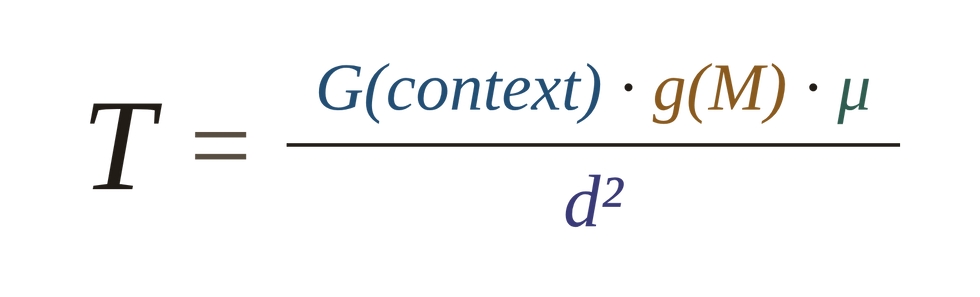
Where μ is the accumulated trust mass (Consistency and Coherence), d² is Relational Distance, g(M) is the Meaning Gate, and G(context) is contextual calibration.
What happened with the incident in ticket´s purchase was not, at its core, a failure of information. It was a failure of Meaning g(M). The system read the transaction as equivalent to my intention, despite I read it through a different psychological contract.
See the expanded information about the Law of Gravity for Trust in the Article The Regional AI Deployment Gap Nobody Is Filling
Applying the Law of Gravity for Trust to analyse my case:
As a client, I read the sequence of communication as the real signal. The purchase was confirmed by email within seconds; another email, with bundled offers, followed soon after.
Until this point of the transaction we can observe:
Consistency = high
Coherence = high
Meaning g(M) = high
Proximity 1/d² = high (d small)
Yet when I returned to the platform less than one hour after the purchase to cancel it, there was no email confirming the cancellation, no note on the usual timeline for the refund, no path back to rebook — fee included. And we see the immediate impact in the user´s trust and retention.
Consistency = low
Coherence = low
Meaning g(M) = low
Proximity 1/d² → collapses (d grows; d² is always positive)
The platform's communication "felt" consistent and coherent... with their values; but it has not showed the same consideration towards the client´s values. What would be the "consistency and coherence" expected? The same in comparison. If there were earlier fast emails for confirmation and even bundled offers, so there should be for other actions. With Meaning, the gate was the lack of attention to what would be strategic to a "mutual-meaningful" interaction.
The procedures may seem correct. And still, the trust signal not.
Note: In this scenario we are applying the Regional Communication Risk Calibration based on the Law of Gravity for Trust with less need for cross-cultural semantic calibration. But the framework also consider semantic calibration in the Meaning Gate g(M).
That asymmetry between consitency, coherence, meaning, and the dual force of the relational distance was the tell: for Flight Network, a cancellation is not worth the investment, and the contract it had actually activated was transactional, not relational. And this has a cost. And not an intangible one, as we see.
Here is what makes this an experiment rather than a complaint - The strategic position with the Meaning Gate g(M)
The Meaning Gate did not close on everything. It closed just on the intermediary agency I landed on — not on the airline, not on air travel, not on the idea of booking online. Here we see that meaning is highly correlated with direct attachment for retention in constrained environments; but not in the full sense. Which facilitate us to understand:
If organizations do not align Meaning in its full value, clients will not lose trust on investing or purchasing. They will distrust specifically that relationship.
Trust is not one undifferentiated quantity; it has an address. And the closure, though decisive for that one relationship, was not catastrophic for the rest: a small, almost costless act at the right moment — me cancelling within the free window and rebooking directly — would restored the relationship I actually needed.
As a disclaimer, I could have stayed with Flight Network. The cancellation itself was handled fairly, and I was adequately guided through it. But the journey as a whole stayed dissonant with my needs and expectations — procedurally repaired, relationally not. In the geometry of the model (Law of Gravity for Trust), that is the inverse square at work: a tiny move at short distance pulls harder than its price suggests.
The gate I had closed on the intermediary did not reopen, because reopening it would have required an act of repair from their side that never came. This reminds me of my project The Cyber-Tower of Babel, where I build semantic matrices focused on small wins for constrained online environments:
While in English we have a single term and meaning for the word forgive, in German
vergeben and verzeihen reveal different psychological contracts that translators and the AI overpass with misaligment in the interpretation and potential impact on trust.
EN: I forgive you.
Possible reality: there is a flexibility for reconciliation and to re-establish trust.
(LLMs reasoning - high possibility for trust reintegration - trust considered to keep interaction)
DE: Ich vergebe dir.
Possible reality: I set the grievance down; I did not restore the trust.
(LLMs and the Meaning Gate)
This whole correction cost me no more than €50 euros — unpleasant, but not a disaster. Expensive enough to command attention; cheap enough to leave no structural damage. An efficient epistemological tuition fee, and an almost laboratory-clean one, because every variable was visible: the outcome was right, the objective was wrong, and the gap between them maps cleanly onto the Law of Gravity for Trust — a set of failures distributed across consistency, coherence, meaning, and relational distance.
Why Personalised comes first - The METAP4-Method
How to ensure the right sequence of actions
There is a deeper reading. In traditional design, personalisation is a product of prediction: a model trained on aggregate, historical data — bias included — produces "personalisation" as its output, and the user is fitted to the prediction. The more we move to the Hyper-Hydrated Society, the more I see the need to update this concept.
The METAP4-Method inverts the dependency: we start with Personalisation.
Personalised → Participatory → Predictive → Preventive.
Personalisation is not the output anymore, (as in the past when data-quantity was still counting higher to predictive models). Now it has become but the initial condition — smart data in a constrained environment, not comprehensive profiling; the user's responses then become the data, and prediction is earned, not assumed. This does not abolish bias; it relocates it — prediction enters later, on local evidence, rather than up front on aggregate assumptions.
With the METAP4-Method prediction is earned, not assumed.
Flight Network failed in the classical direction: it began from a predictive assumption — ALFES wants to complete the purchase, she wants more offers — and personalised on top of it, while the initial condition that actually mattered (which relationship I wanted) was never created.
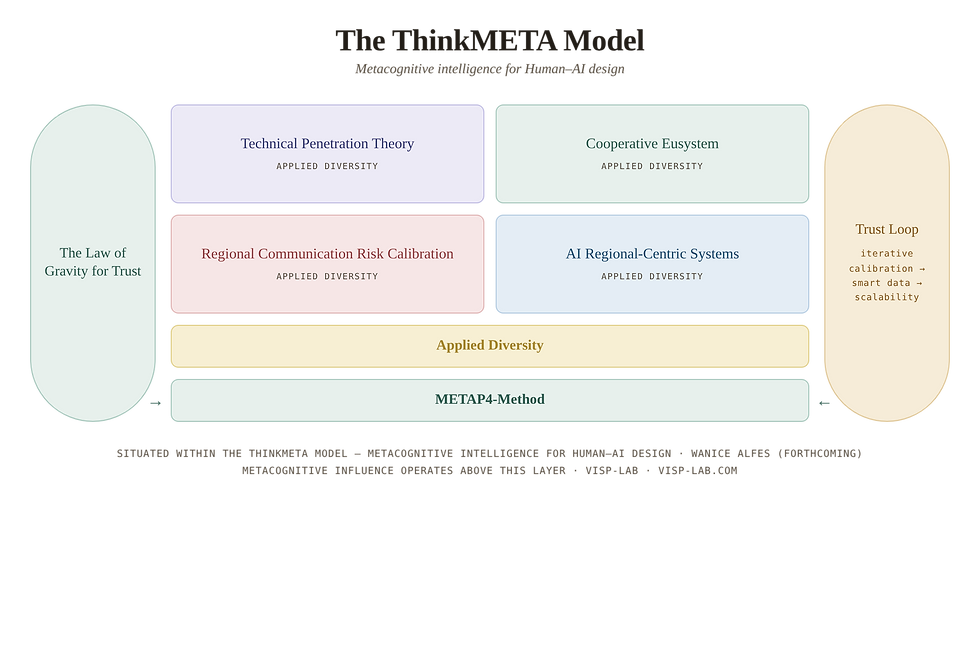
This is why, at ViSP-Lab, a framework matters less alone than in coordination. The Law of Gravity for Trust locates where trust lives, RCRC keeps it observable, the METAP4-Method sequences how it is built, and the AI Deployment Ecology gives that sequence somewhere to run — all under the ThinkMETA Model. A good insight is not a design. The coordination is the design.
Why this matters for user retention
This is why I keep questioning the contemporary obsession with optimisation. Organisations ask how to increase conversion, engagement, adoption — and, increasingly, user retention and customer lifetime value (CLV). Reasonable questions, but they skip a prior one: what, exactly, are we measuring?
A system can optimise behaviour beautifully while quietly losing its grip on reality. The dashboard improves, the model improves, the intervention improves — and the organisation slowly loses sight of whether the behaviour it sees reflects genuine alignment or merely a response to its own intervention. The outcome stays visible. Its meaning does not.
This is the error Regional Communication Risk Calibration is built to catch: not a failure of data, but answering the wrong question with precision — the error of the third kind. RCRC is, at heart, a measurement discipline. It detects which psychological contract a given interaction has actually activated, and calibrates communication to reveal that state rather than overwrite it. Communication should be enough to expose the relevant variable — never enough to force it.
Regional Communication Risk Calibration (RCRC) — the discipline of preserving observability in systems where communication is powerful enough to alter the outcome being observed.
What I take from my mistake with the wrong tickets
A few working principles, sharpened by a fifty-euro lesson:
Name the relevant variable before optimising the measurable one. "Buy a ticket" and "own the relationship behind the ticket" look alike and behave nothing alike.
Ask according to which metric? Treat every "outcome achieved" as incomplete until the objective behind it is named.
Design for the Meaning Gate. Detect the contract the user is actually operating under; do not assume a default and proceed on a trust that was never granted.
Keep mistakes cheap and reversible. The 24-hour cancellation window was, in effect, a repair operator. Systems that build in fast, low-cost repair recover trust that systems optimised only for conversion never get back.
Mind the Supermarket of Placebos. A precise measurement of the wrong thing is more dangerous than an honest gap in the right one.
Measuring the wrong thing, with precision
The most expensive mistakes are rarely caused by missing information. They are caused by measuring the wrong thing with extraordinary precision and not care on the Meaning Gate. In Human–AI systems, that distinction may decide whether we are observing trust — or merely the residue of our own interventions. This is what I call Metacognitive Influence - moving from strategies in behavioral economics to relationships on trust. We keep the topic for the next artcile.
If your dashboards read "success" while your users feel otherwise, that gap is exactly what ViSP-Lab is built to find.
Work with ViSP-Lab
ViSP-Lab advises organizations operating in complex Human–AI environments — on the alignment of meaning, trust, and interaction across systems, teams, and regions.
Consultancy · Keynotes & Workshops · Editorial reviews of ThinkMETA (forthcoming). →

Start a conversation with ALFES
ViSP-Lab · Human–AI Cognitive Engineering
ViSP-Lab is an independent research and development laboratory based in Bad Homburg, Germany. The lab investigates how trust, communication, cognition, and regional interpretation shape cooperation between humans and AI systems.
ViSP-Lab Working Paper WP01-2026: Regional Human-AI Design is available on request. Contact ViSP-Lab → · Read the blog series → · About the lab →